
Events

22st annual art exhibit and open studios of the 2015 artists in residence at Art Farm
noon to 5PM
October 24 and October 25.
There currently is not much on this page, but by next fall, we will start to fill in the information about the next Art Harvest and as things fall in place, we’ll add more info until all the boxes are full, until then there is hardly any need to check often for the latest updates. However, you might wish to peek at some of the previous events from the list to the right as evidence of Art Farm's determined dedication to public outreach, a little more than what initially seems apparently lacking on this page.
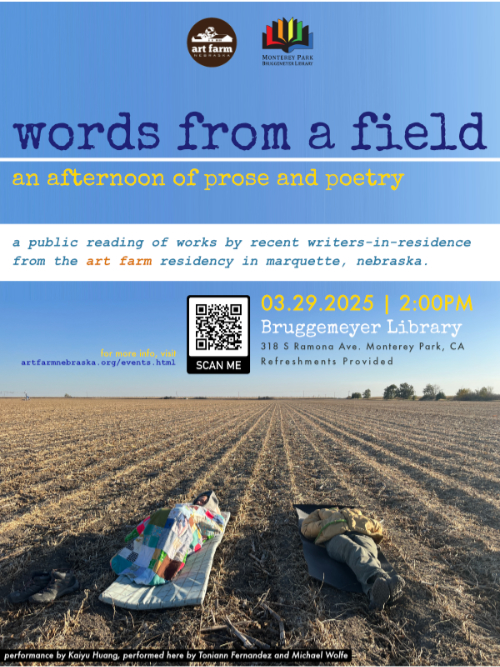
In constellation (but unaffiliated) with the AWP national writer's conference in Los Angeles, California, Art Farm cordially invites you to a reading event occuring in the Friends Room on the 2nd Floor at Bruggemeyer Library in Monterey Park, California on March 29, 2025 at 2:00pm.
Breaking news
Our five featured readers
Annakeara Stinson
Cass Eddington
Ethan Evans
Juliet Gelfman-Randazzo
Marissa Sher
Refreshments Menu
This top secret information
will be revealed 2 days prior to the event.
Revealed
Art Farm has been agonizing for months, planning and coordinating how best to deliver a sliver of authentic Nebraskan experience to our Los Angeles venue. Finally, the perfect solution has been discovered. Event goers may find that the reception will both sparkle and pop, and accommodate most dietary limitations.
Latest Hot Gossip
Bringing you the latest, hottest Goss to thaw the silence of your day: Weeks after the events page went live, people have been braving subzero temperatures to travel to the sacred fields of Art Farm only to be disappointed that the event will actually be held in Los Angeles, California. Thankfully, attendees to our March event will not be held back by deceiving snow drifts or elusive mud holes; instead they will be welcomed with unfortunately raccoon-free parking spaces on asphalt.
Directions
The most cost efficient method may be, from the LA Convention Center, to ride the Los Angeles Metro 'E' Line in the direction to East LA all the way to Atlantic Station (end terminal). From that station, ride sharing with Uber or Lyft to the event (318 S Ramona Ave, Monterey Park, CA 91754) should also be the most affordable.